Your First RV Trip: A Shakedown Checklist
Plan a first RV trip in a used RV with a shakedown close to home, a departure checklist, driving and parking tips, and the mistakes that catch new owners.
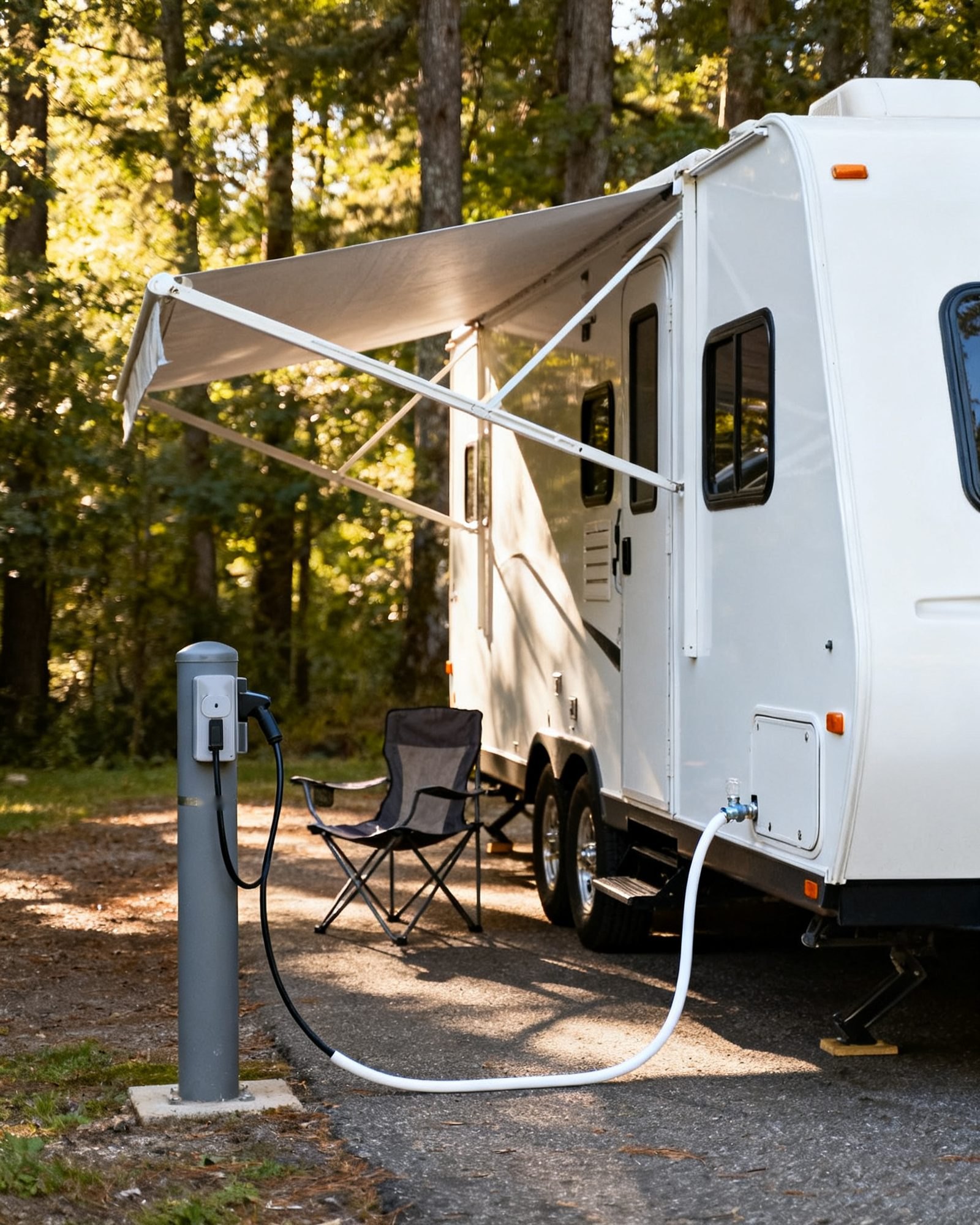
A first RV trip in a used RV should be a shakedown run: a short stay at a campground close to home, ideally within an hour or so of it, so that anything that fails can be fixed at home or with familiar help nearby. Leave the long trip for later. The goal of the first outing is not distance; it is to find out how the RV behaves when loaded, how the systems work when actually used, and which habits need to be built before a longer journey.
Why the first trip should be a shakedown, not a vacation
A used RV has often sat for a while before it is sold. Seals dry, batteries go flat, tires age, and the previous owner’s habits are unknown. A shakedown trip puts the RV under load for a short time and exposes the weak points while the consequences are small. Pick a campground with full hookups so that water, electric and sewer can be tested one at a time, and keep the drive short enough that a return home is easy if something major fails.
Before the first trip, the RV should have had a basic inspection and any obvious defects corrected. If that has not happened, do it first. A used RV that has not been checked is not ready for a first trip.
The RV departure checklist
Use a written checklist every time, not memory. The same list serves the first trip and every trip after it. Print it, laminate it, and keep it in the RV.
| Area | Check |
|---|---|
| Steps | Retracted and stowed; entry door latched |
| Antenna and roof vents | Down and closed; roof inspected for anything left up |
| Slides | Fully retracted; seals seated; nothing caught in the mechanism |
| Jacks and levelers | Fully up; pads stowed |
| Hitch (towables) | Coupler latched and pinned; safety chains crossed; breakaway cable attached; weight-distributing bars set |
| Lights | Running lights, brake lights, turn signals, marker lights working on RV and tow vehicle |
| Tires | Pressure checked cold; sidewalls and tread inspected; lug nuts checked |
| Propane | Tank or cylinder valve open only as needed; detector working; no smell of gas |
| Fridge | Set to the correct mode for travel; door latched |
| Doors and compartments | All latched; awning secured |
| Inside | Loose items stowed; cabinet latches closed; nothing on counters |
| Mirrors and height | Mirrors adjusted; height written where the driver can see it |
For a towable, the hitch, brake controller and sway setup deserve their own walk-around. The details are covered in towing a travel trailer.
Propane and electrical checks belong to a technician
Running the fridge and water heater the way their manuals describe and pressing the LP detector’s test button are normal owner checks. Leak testing, regulator and appliance repairs, and wiring work are not. If the propane system has not been checked, or if there is any smell of gas, have a qualified RV technician inspect it before the trip. The same applies to 120-volt wiring, the converter, the inverter and the generator. The owner’s job is to know the systems work, not to repair them.
Driving a large vehicle for the first time
A motorhome or a truck-and-trailer combination is longer, heavier and slower to stop than a passenger car. The first drive should be on quiet roads, in daylight, with no time pressure. Practice turning, backing and stopping before loading the family and the gear.
- Know the exact height, including roof air conditioners and antennas, and keep it written where the driver can see it.
- Swing wide on turns; the rear wheels track inside the front wheels, and a long rear overhang swings out the other way.
- Leave more following distance than in a car, and brake earlier.
- Use a spotter when backing, and agree on hand signals before starting.
- Check the route for low bridges, narrow roads and weight restrictions before setting out.
- Take a break every couple of hours; driving a large vehicle is tiring.
Parking is its own skill. A pull-through site is easier than a back-in site for a first trip. If the campground offers help, take it.
Arriving and setting up
Set up in the same order every time. Stop, chock the wheels, and only then unhitch or level. Connect water with a drinking-water hose and a pressure regulator, connect electric, and connect sewer last. Keep the black tank valve closed until the tank is mostly full, then dump black first and gray second. The full sequence is in RV water systems.
Hookups vary from full to none, and the campground’s rules and site length matter more than they seem. Many older public campgrounds have sites too short for large RVs, so check the site length before booking. The differences are set out in RV campgrounds and hookups.
What usually goes wrong on the first trip
The failures that catch new owners are rarely dramatic. They are the small things that were not checked.
- The steps left out. Driving off with the steps extended damages them and whatever they hit.
- The antenna up. A roof antenna left raised meets the first low branch or bridge.
- The fridge on the wrong setting. Food spoils, or the battery drains.
- A flat or aged tire. Used RV tires often age out before the tread wears out. Check the DOT date code on the sidewall and inflate to the pressure for the actual load.
- The battery dead after a night off hookups. The coach battery may be old or undersized for the load.
- A water leak at a fitting. A pressure regulator and a careful check at the tap prevent most of them.
- The black tank valve left open. Solids pile up and the tank does not drain properly.
- A propane or electrical fault. This is the one to stop for. Do not attempt repairs; have a qualified RV technician look at it.
- Overloading. The only way to know actual weight is a public scale, loaded, by axle where possible. Check the weight ratings before adding gear.
After the first trip: build the maintenance habit
A shakedown trip is also the start of a maintenance record. Note what worked, what failed and what was replaced. A used RV needs a seasonal routine: roof and seam sealant inspection, tire checks, battery care, water system winterizing and appliance checks by a technician where required. The schedule is in RV maintenance.
Keep the departure checklist with the RV, and update it after every trip with anything that was missed. The list gets shorter as habits form, but it should never be abandoned.
Common questions
How far should a first RV trip be?
Keep it short and close to home, ideally within an hour or so, so that a failure can be handled easily. The purpose is to test the RV and its systems, not to cover distance.
What should be on an RV departure checklist?
Steps, antenna, slides, jacks, hitch, lights, tires, propane, fridge, doors and loose items inside. Check them in the same order every time and keep the list in the RV.
Can I check the propane system myself before a first trip?
You can check that the detector works and that there is no smell of gas. Any work on the propane system, including leak testing, regulators and appliances, is a job for a qualified RV technician.
What usually goes wrong on a first RV trip?
Left-out steps, a raised antenna, a fridge on the wrong setting, aged tires, a dead battery and water leaks are common. Propane or electrical faults should stop the trip until a qualified RV technician has checked them.
Do I need a special license to drive a large motorhome?
The federal commercial driver's license does not apply to personal-use RVs, but some states require a special non-commercial license or endorsement for heavy motorhomes or long combinations. Check your state DMV.
Read next
RV Campgrounds and Hookups: Full Hookup to Boondocking
Full hookup, partial hookup or no hookup at all: how RV campgrounds and public-land camping work, what each site gives you and how to pick one.
RV Maintenance Checklist: A Seasonal Schedule for a Used RV
A practical RV maintenance checklist for used motorhomes, campers and trailers: what to check before each trip, monthly, each spring and fall, and yearly.
RV Propane Safety: Tanks, Leaks and Detectors
How an RV propane system works, ASME tanks vs DOT cylinders, OPD valves, requalification, refilling, leak signs, alarms and what to do if you smell gas.